Anthony Santaro
Interviews
·
The Steel Toe Boot Test
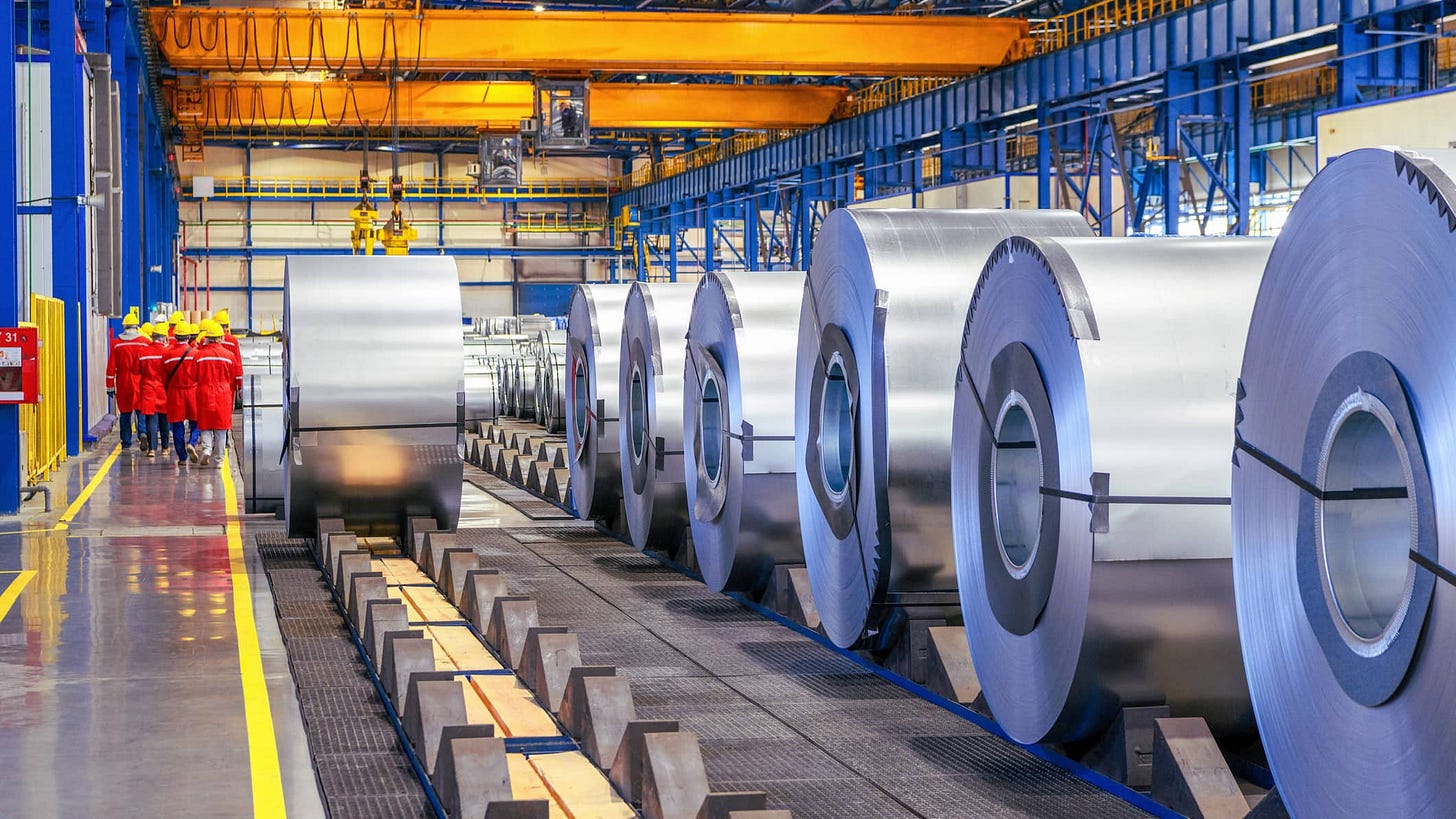
At Armory, we spend a lot of time searching for places where advanced technology meets old-line industry. Few companies embody that intersection better than our most recent investment, Shelfmark. Ahead of the announcement of their Seed Round, which Armory led, Shelfmark cofounder Pat O’Donnell sat down with me to discuss the “sleeping giant” of continuous flow manufacturing, why a 100-micron defect is such a hard problem, and how a Pittsburgh industrial engineering background shapes the way his team shows up on the factory floor.
Anthony Santaro (AS): Pat, take us back to the beginning. You and I first met two or three years ago, and Shelfmark looked quite different then. Walk us through Shelfmark v1 and the pivots along the way.
Pat O’Donnell (PO): Shelfmark didn’t start out as Shelfmark. It started as a broader thesis: there’s all this incredible technology coming out of Carnegie Mellon, and it tends to go straight to the coasts. We weren’t seeing enough people using that technology to solve problems for bedrock industries in communities like Western Pennsylvania and Upstate New York. So the thesis was that if we could get close enough to real customers in deep industrial segments, we’d learn what problems they actually needed solved, and then go find the right technology to solve them.
By nature, that meant we didn’t set out to build a production intelligence company. We set out to solve meaningful problems. The name Shelfmark comes from the fact that we started as a distribution solution for retail stores. But as we dug in and put our customers first, we were pulled more and more toward manufacturing, and specifically toward inline visual inspection. We quickly learned that the continuous flow market was so wildly underserved that humans are still standing on the line watching product roll by, looking for defects.
Shelfmark started four years ago, and I call that first couple of years product-market-fit purgatory. We tried things, iterated, failed. But we kept two principles in mind: solve meaningful problems for customers, and build a business that can scale globally and drive a billion-dollar outcome. That’s what led us here, and it happens to be a perfect fit, pairing my industrial engineering background with the depth of technical expertise on our team.
AS: Give us the master class. What’s the difference between continuous and discrete manufacturing, and why did you settle there?
PO: Continuous flow manufacturing is considered the sleeping giant of the industry. It’s almost impossible to truly estimate, but by some measures it’s as much as 30% of global manufacturing. All it means is product made on reels or rolls, in one continuous step: pieces of fabric, rolled metals that become the surfaces of our cars, industrial films that create insulative layers and become batteries.
The best way to understand rolled goods is to look around the room you’re in, or the car you’re sitting in, and think two or three steps up the supply chain. The products that become the products that become your desktop or your windshield started on a roll. That’s the market we serve.
Meanwhile, there’s plenty of funding and attention going to complex assembly and discrete products, like automotive components and PCBs. There are plenty of companies building inspection solutions, humanoids, and co-bots for those industries. But in the meantime, 30% of global manufacturing has gone totally underserved.
AS: And continuous is arguably the harder problem. Can you double-click on speed?
PO: Speed is everything. At the most basic level, discrete products are infinitely easier to inspect, in part because you can do it with an off-the-shelf camera. With continuous flow, you need specialized cameras capturing at speeds as fast as 800 feet a minute or beyond. When you’re looking for 100-micron defects at those speeds (for reference, the width of a human hair is about 100 microns) that’s not something you do with your iPhone or a webcam you bought off the internet.
It creates a unique technical challenge where our team needs expertise across hardware, software, and machine learning. That’s a real barrier, and a real moat. And frankly, being in Pittsburgh is a tremendous advantage: it’s a bedrock of physical AI, and we can attract the talent to solve this problem scalably.
AS: Say more on the moat. You’ve built a platform here, not just a product.
PO: Playing in this blue ocean has allowed us to essentially be the standard-bearers for applying deep learning computer vision in this market. We’re able to apply proprietary algorithms and proprietary post-processing steps to elucidate those 100-micron defects at high rates of speed. So not only is it a hard problem to solve, we’re also building a moat around the IP by moving quickly.
And I think we’re just scratching the surface. There’s so much more that can be done with different sensor types, with collecting more environmental data in the production environment. We’re fortunate to have a team of Carnegie Mellon engineers deep in computer vision who let us keep pushing the boundaries of what’s possible.
AS: Speaking of CMU, that’s where you met your cofounder, Craig Markovitz. Tell us about him and how you two came together.
PO: First things first: Craig and I won’t fool anyone. We come from the business school, the non-technical side of campus, which has its own incredible legacy, and also gives us access to the technical talent across the rest of campus.
Craig is a successful serial “physical AI” entrepreneur, although back when he started, we just called it robotics. He sold his last company about ten years ago and went to teach at Carnegie Mellon to give back to the next generation of entrepreneurs. I took his class about seven years ago and was enamored with everything he taught: how to approach customer-led solutions, how to build in a scrappy and thoughtful way.
I tell folks I more or less conned him into starting a business with me. He’s had hundreds, if not thousands, of students over the last decade, and I’m fortunate to be the only one he’s ever gone into business with as a cofounder and early investor. That relationship has only grown. I have all kinds of admiration for the integrity he works with and the leadership he brings to his teams, and Shelfmark is incredibly fortunate to benefit from his network in the Pittsburgh region, in physical AI, and at Carnegie Mellon. We wouldn’t be where we are without his expertise, and his gray hair. He’s been there, done that.
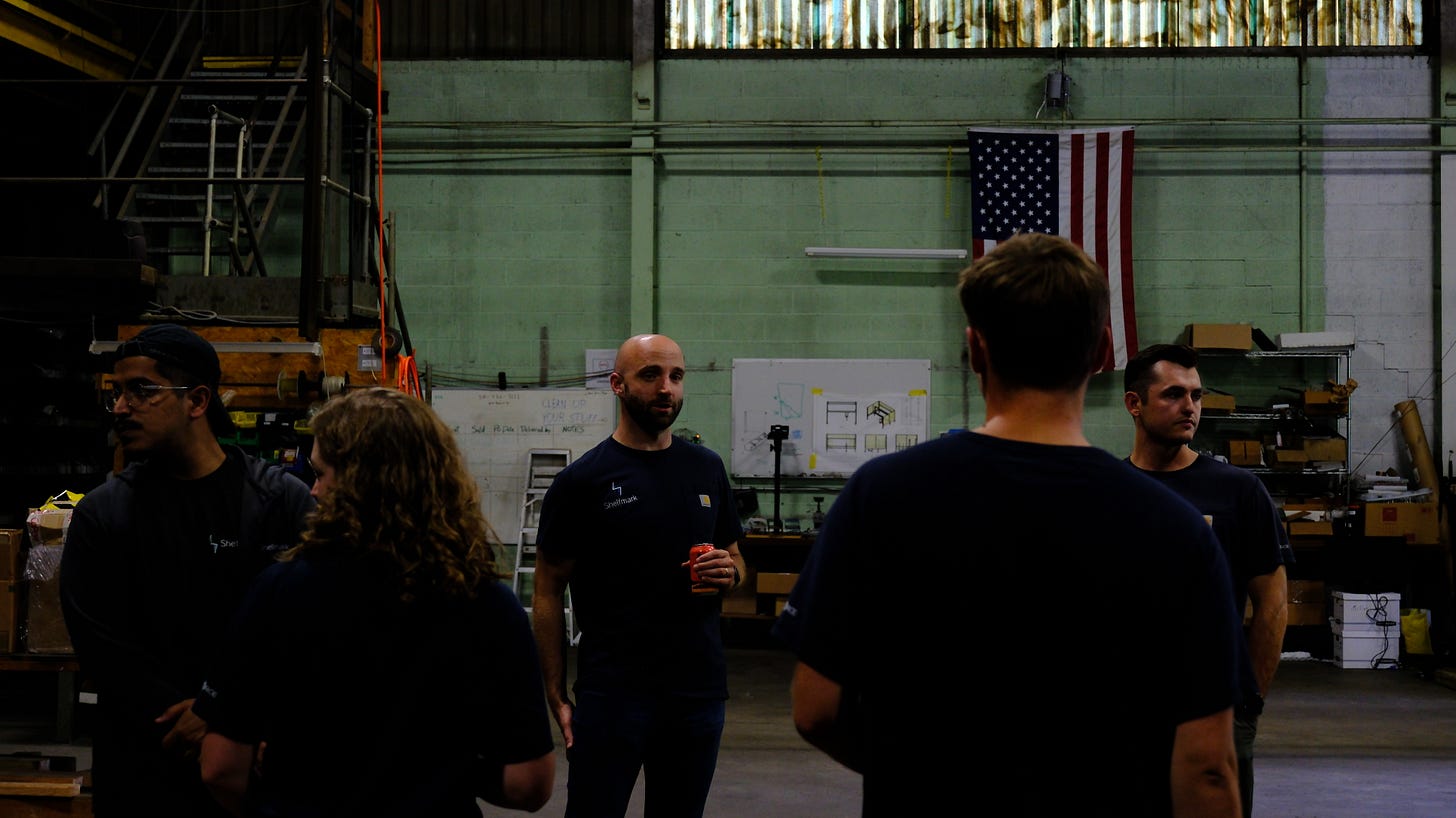
AS: Let’s stay on Pittsburgh. How do those roots show up in the way you work with customers?
PO: For those who don’t know Pittsburgh, it’s an industrial city reborn with advanced technology, healthcare, and financial services. But the bedrock of Pittsburgh to this day is Fortune 500, multibillion-dollar industrial companies. I attended the University of Pittsburgh for undergrad, studied industrial engineering, and I’ve been in and out of factories all over this region since I was 19.
I tell folks we hire engineers who owned steel-toed boots before they started at Shelfmark. Which more or less means they’re comfortable on the factory floor. They either come from that world or their relatives do. My great-grandfather grew up across the river from me on the South Side working in the steel mills, and that’s the common thread through anyone in this region.
So building relationships with our customers is natural. It’s not contrived, it’s not a playbook, it’s not speaking a certain language. We’re just a vendor our customers trust to provide them with value. In this case, it happens to be through some really cutting-edge technology. I won’t speak for our customers, but I hope the shared heritage and shared mindset makes us collaborate more closely than if we were parachuting in from Silicon Valley.
AS: Reindustrializing America has become a real political movement on both sides of the aisle. Noise, or meaningful?
PO: Important context here: my family dates back in Western Pennsylvania to the 1750s. Generations and generations, mostly in blue collar jobs. So it’s incredibly close to me, and to the mission of the company, that we reindustrialize here.
I think Shelfmark plays a small but meaningful part in making that viable. One of the biggest keys to reshoring is having the automation and technology in place to make the numbers work. And that’s a huge part of what we offer. We talk a lot about how our customers aren’t laying off workers because they put Shelfmark on the floor. They’re empowering their workers to move into higher-dignity, higher-skilled jobs, instead of watching something roll by on a line. The more we can automate these mundane processes, the easier it becomes to reshore manufacturing activity.
AS: One thing that attracted us as investors is that Shelfmark drives ROI on both sides of the income statement — reducing waste, but also increasing throughput. Can you make that tangible?
PO: I’ll give you a real example. We just came back this week from one of our largest customers, where we ran an in-flight case study. We’re creating a 4x ROI for them on waste alone. Take what they’re paying us monthly, multiply it by four, and that’s what we’re saving them every month in scrap on that line. Then layer on the labor savings of not having someone picking through materials or babysitting the line.
On the top line, customers see impact two ways. First, they can produce more: run faster, run more shifts, output more product. To your point on tailwinds, all of our domestic customers want to produce more, because there’s demand for their products. Second, our customers are starting to promote Shelfmark as a representation of quality. Being able to say they’re inspecting 100% of what comes off their line with AI gives their customers confidence. We’re seeing more and more of our expansions driven not by our customers alone, but by our customers’ customers.
The ROI is tangible enough that it can be proven in an afternoon. Spend two hours watching the line and it becomes apparent.
AS: You just ran an oversubscribed fundraise process. What were you looking for in a lead investor?
PO: Craig and I ran our process very intentionally. We weren’t just looking to take capital, we were looking to take on partners. We feel strongly about self-selecting for not just good investors with good networks and checks that cash, but for good, thoughtful people who want to build businesses the right way.
Armory was instrumental in putting together the syndicate that ultimately helped us oversubscribe, and in making value-add introductions, from the earliest days right through to last night, when you texted me a customer intro. In the founder seat it’s easy to think of capital as commoditized: you just need a check, and once you have it you can go. But this is a much deeper partnership, and every step along the way Armory and the rest of our investment group has treated it as such.
When we talk about the culture of Shelfmark, and building for Middle America and this left-behind manufacturing segment, being a good person is a massively important quality in a partner.
Rapid Fire Questions
Favorite restaurant in Pittsburgh? A small Italian place in my old neighborhood called Severina. It looks like a laundromat from the outside and has the best homemade Italian food you could ever ask for.
What year do the Pirates win the World Series? I hope I’m alive to see it. If there’s a salary cap in place next year, 2037. If there’s not, never.
Steelers regular season record this year? Nine and eight, just like the last several years. Aggressively mediocre, but consistent.
If you couldn’t be a tech founder, what would you do? It’s probably a good thing that I have a hard time answering this. Most likely running one of the industrial businesses we serve. Honestly, once we’re wildly successful with Shelfmark, my next step might be running this playbook from the other side of the table, rolling up industrials businesses and building physical AI into them. I feel that passionately about these businesses.
Favorite or recent book? I’ve been reading a lot of parenting books. We’re expecting in September. So a shout-out to Emily Oster, the economist who’s written a series of parenting books for highly analytical people who want the math and science behind raising a child.
Who or what has been your greatest inspiration? My dad. He’d qualify as the business answer, too.
Another business leader you look up to? Jack Welch. I read all of his books growing up. Fellow Irishman, with Upstate New York roots.
Share: